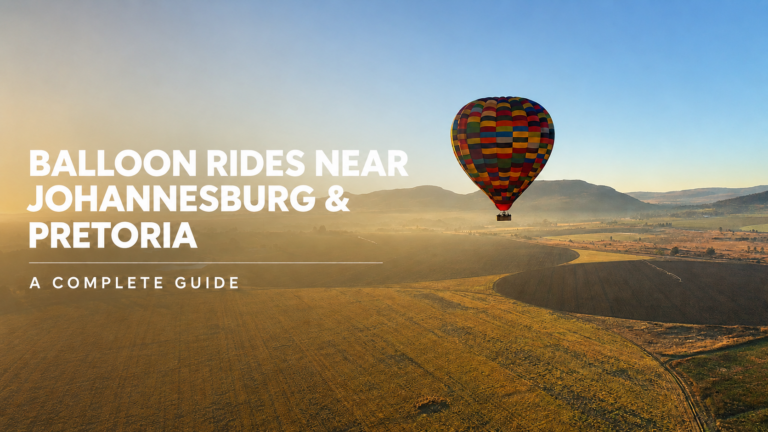
Why do hot air balloons fly at sunrise? The answer lies in the weather conditions typically found during the early morning, when the atmosphere is generally cooler and more stable.
Passengers usually arrive before dawn, watch the balloons inflate as the sky begins to brighten and take off shortly after sunrise. The timing is not chosen simply because sunrise photographs look beautiful, although that is certainly a welcome advantage.
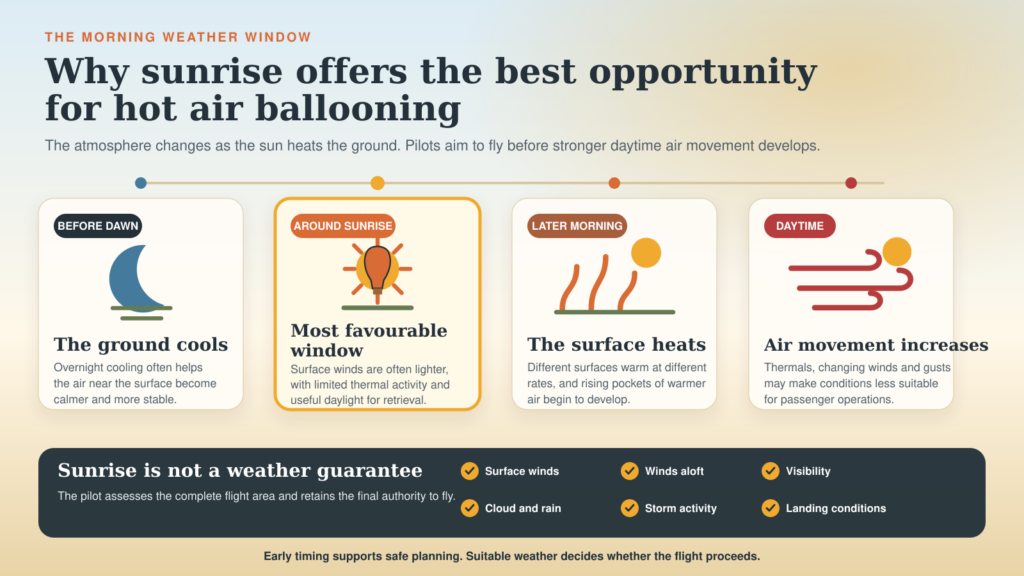
As the sun rises and begins heating the ground, air movement gradually changes. These changing conditions can create stronger winds, rising columns of warm air and turbulence that may be less suitable for passenger balloon operations.
For Bill Harrop’s “Original” Balloon Safaris, flights take place at sunrise only. Here is why the early start is an essential part of the experience.
Why Do Hot Air Balloons Fly at Sunrise? The Quick Answer
Hot air balloons generally fly around sunrise because:
- Surface winds are often lighter in the early morning
- The atmosphere is usually more stable
- The ground has not yet been strongly heated by the sun
- Thermal activity is generally limited
- Pilots can assess the developing conditions from the launch site
- Cooler air can support more efficient balloon performance
- The flight can normally be completed before daytime heating becomes established
Sunrise does not automatically guarantee suitable flying weather. Wind, rain, fog, visibility, thunderstorms and other aviation weather conditions must still be assessed before every flight.
The final decision to fly always rests with the pilot.
How does a hot air balloon fly?
A hot air balloon flies because the air inside its envelope is heated by the burners.
As the air inside the balloon becomes warmer than the surrounding atmosphere, it becomes less dense. This creates lift and allows the balloon to rise.
The pilot controls the balloon’s altitude by heating the air inside the envelope or allowing it to cool. However, a balloon does not have an engine or steering system that allows it to follow a predetermined route.
Instead, it travels with the wind.
Pilots use their knowledge of the local area, aviation weather and the different wind directions available at various altitudes to manage the flight. This makes the condition and movement of the surrounding atmosphere especially important.
What happens to the atmosphere overnight?
After sunset, the ground begins losing the heat it absorbed during the day. As the ground cools, it also cools the air immediately above it.
During a clear night with light winds, this cooling can help create a more stable layer of air near the surface. By the time morning arrives, the atmosphere may be relatively settled.
The Federal Aviation Administration’s Balloon Flying Handbook explains that the Earth’s surface heats during the day and cools at night. It also notes that convection develops when sun-warmed ground heats the air above it, causing warmer air to rise.
This daily cycle of heating and cooling is one of the main reasons balloon flights are planned for the early morning.
What changes after sunrise?
Once the sun rises, it begins heating the surface of the Earth.
Different surfaces heat at different rates. Dry soil, grass, rocks, trees, buildings and bodies of water do not all respond to sunlight in the same way.
As warmer areas heat the air above them, pockets or columns of warm air begin to rise. These are commonly known as thermals.
Cooler surrounding air moves in to replace the rising air, creating vertical and horizontal movement within the atmosphere. As daytime heating becomes stronger, these movements can become more active and less predictable.
Glider pilots actively seek thermal activity because rising air can help keep their aircraft aloft. Balloon pilots generally prefer to complete passenger flights before strong thermal activity develops.
A balloon is a large, relatively slow-moving aircraft that travels within the surrounding air mass. Strong thermals, gusts and turbulent air can affect its climb, descent and landing.
Why lighter surface winds matter
Wind speed at ground level is particularly important during balloon preparation, inflation, take-off and landing.
Before launch, the balloon envelope is spread across the field and filled with cold air. Once it is sufficiently inflated, the burners are used to heat the air and raise the envelope into its upright position.
Stronger or gusty surface winds can make this process more difficult. The envelope presents an enormous surface area to the wind, while the basket and passengers remain close to the ground.
Surface conditions are also important when landing. The pilot must identify a suitable landing area and consider wind speed, terrain, obstacles, access and the space available.
A balloon landing may involve some movement after the basket first touches the ground. Stronger winds can increase the speed across the ground and the distance needed to bring the aircraft to a stop.
This is why a morning that appears perfectly pleasant for an outdoor walk may not necessarily be suitable for a commercial balloon flight.
Does cooler air help the balloon fly?
Temperature also affects balloon performance.
A hot air balloon creates lift through the temperature difference between the heated air inside the envelope and the cooler air outside it. Cooler, denser morning air can provide favourable performance conditions.
This does not mean balloons cannot operate during warmer seasons. Bill Harrop’s operates throughout the year, subject to suitable weather conditions.
However, seasonal temperatures, passenger weights, balloon capacity and atmospheric conditions all form part of flight planning. Accurate passenger weights are therefore required when making a reservation.
They are not requested out of curiosity. They are an essential part of safe aircraft and passenger allocation.
Why not fly later in the morning?
Passengers sometimes ask whether a flight can simply be delayed until 08:00, 09:00 or even later.
Unfortunately, hot air balloon flight times cannot be moved according to breakfast preferences, hotel check-out times or the convenience of a special occasion.
By later in the morning:
- The ground may already be warming
- Thermal activity may be developing
- Surface winds may be increasing
- Wind direction may be changing
- Gusts may become more frequent
- Landing conditions may be less favourable
The exact rate at which conditions change differs from one day to the next and from one season to another. This is why the pilot considers the complete weather picture rather than relying on the time shown on a clock.
The aim is to prepare, launch, fly and land within the most suitable operational window available that morning.
Why not fly at sunset?
In some parts of the world, balloon operators may conduct late-afternoon or evening flights when local conditions permit.
Bill Harrop’s “Original” Balloon Safaris does not offer sunset balloon flights. Our commercial passenger flights take place at sunrise only.
By late afternoon, the atmosphere has been influenced by a full day of heating. Even when surface winds appear to calm near sunset, conditions at different altitudes may remain unsuitable or may not provide a sufficiently reliable operational window.
A sunset flight would also require the balloon to take off, complete its flight and land before darkness. Because a balloon’s route and landing location cannot be predetermined, the available daylight becomes another important limitation.
Our sunrise-only operation provides time for a properly planned flight, landing and retrieval in daylight.
Does sunrise guarantee good weather?
No. Sunrise often provides the most suitable part of the day for ballooning, but it does not guarantee that a flight will take place.
Conditions that may prevent a flight include:
- Strong surface winds
- Excessive winds at flight altitude
- Gusty or rapidly changing winds
- Rain
- Thunderstorms
- Poor visibility
- Low cloud
- Fog
- Unfavourable wind direction
- Unsafe or unsuitable landing conditions
- Approaching weather systems
Weather forecasts are an important planning tool, but the final decision may only be possible after the pilot has reviewed the latest aviation weather and assessed the actual conditions at the launch site.
A general weather application showing sunshine is not sufficient for balloon-flight planning. Such applications are designed for everyday public use and may not show the detailed wind, visibility, cloud and atmospheric information required for aviation decisions.
Why can the flight be cancelled when the weather looks fine?
This is one of the most frustrating parts of weather-dependent aviation.
Passengers may arrive to find clear skies and very little wind at the Clubhouse, yet the pilot may still decide that the flight cannot proceed.
Conditions at the launch site represent only one part of the planned operation. The pilot must also consider:
- Wind at different altitudes
- Conditions along the likely flight direction
- The availability of suitable landing areas
- Forecast changes during the flight
- Weather systems approaching the area
- Ground conditions after recent rain
- Visibility and cloud development
A balloon may launch in one place and land several kilometres away. The complete flight area must therefore be considered.
The decision is not based on whether the morning looks attractive from the veranda. It is based on whether the pilot believes the entire flight can be conducted safely.
Why does the meeting time change during the year?
Sunrise does not occur at the same time throughout the year.
During the South African summer, sunrise takes place earlier. Winter sunrises occur later. Passenger meeting times therefore change according to the season and the operational requirements for the flight.
Your reservation confirmation will state the required check-in time for your flight date.
Passengers should not rely on a meeting time from:
- A previous flight
- An old email
- A friend’s reservation
- A social media post
- A general time found through an online search
Always use the time provided in your current reservation confirmation.
Why must passengers arrive on time?
The pilot and crew work within a limited morning weather window.
Before take-off, the team must complete:
- Aircraft and equipment preparations
- Aviation weather assessments
- Passenger check-in
- Passenger and weight verification
- Balloon allocation
- Operational documentation
- The passenger safety briefing
- Balloon inflation
- Boarding
Late arrivals cannot simply be added after the balloon is prepared to depart. Delaying the operation for one passenger may affect every other passenger and reduce the suitable flying time available to the pilot.
Plan your route in advance, allow for road conditions and arrive at the scheduled check-in time.
You can review the directions to our Skeerpoort launch site before travelling.
What can passengers expect from the early start?
The pre-dawn arrival is part of the balloon-safari experience.
Passengers check in at our Clubhouse Pavilion and Restaurant, where tea, coffee and hot chocolate are served while the morning preparations are completed.
As the sky begins to brighten, the balloon envelopes are laid out and inflated across the launch field. The burners are ignited, the balloons rise into their upright positions and passengers are called forward for boarding.
The approximately one-hour flight is followed by sparkling wine and orange juice after landing, return transport to the Clubhouse Pavilion and a full English buffet breakfast.
The complete experience takes approximately three to four hours.
You can read our guide explaining what to expect from a hot air balloon safari for further information about the flight, landing, clothing and passenger requirements.
Sunrise is part of safe balloon operation
Hot air balloons do not fly at sunrise merely for dramatic photographs.
The early timing is closely connected to atmospheric stability, surface winds, thermal development, landing conditions and the daylight available for the complete operation.
There will always be mornings when the alarm feels rather ambitious. Once the balloons begin to inflate against the first light over the Magalies River Valley, however, the reason for the early start becomes considerably easier to understand.
Our flights operate throughout the year from our private launch site in Skeerpoort, near Hartbeespoort, subject to suitable weather conditions and availability.
Explore our Magalies River Valley hot air balloon safari or contact our Reservations team to enquire about available flight dates.
Thank you for your continued support. We look forward to welcoming you on board.