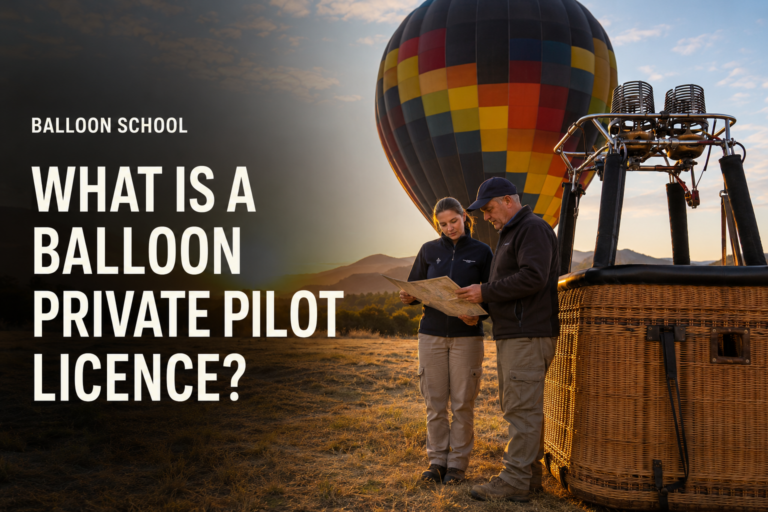
Before an applicant can receive formal acceptance into the Balloon School training programme, they must complete a compulsory Training Introductory Flight.
This is not a passenger experience or a casual trial flight. Instead, it forms part of the Balloon School’s pre-enrolment and assessment process.
The flight gives the applicant practical exposure to balloon operations. It also allows the Training Provider to assess whether the applicant understands the environment, responsibilities and commitment involved.
Why Is the Training Introductory Flight Compulsory?
Hot air balloon pilot training requires more than an interest in flying. Students must work safely around aircraft equipment, follow instructions and participate in ground operations.
They must also understand that balloon training is weather-dependent and competency-based. As a result, training cannot follow a guaranteed timetable.
The Training Introductory Flight allows both the applicant and the Training Provider to make a more informed decision before formal enrolment.
What Is the Purpose of the Flight?
The Training Introductory Flight introduces the applicant to the practical training environment.
It may include exposure to:
- Pre-flight planning and weather considerations
- Balloon equipment and aircraft systems
- Launch-site preparation
- Basket, burner and fuel-system checks
- Inflation and launch procedures
- Ground crew responsibilities
- Communication between the pilot and crew
- In-flight procedures and pilot decision-making
- Landing and recovery operations
- Post-flight aircraft and equipment procedures
The instructor may also discuss the licensing pathway, training structure and responsibilities of a student pilot.
It Is an Instructional Experience
A Training Introductory Flight differs from a commercial balloon safari.
The applicant attends as a prospective aviation student. Therefore, the focus is on observation, instruction and participation in the operational process.
The instructor may explain why particular decisions are made throughout the operation. These decisions may relate to weather, launch conditions, airspace, navigation, landing options or crew coordination.
Applicants should ask questions and pay close attention. However, they must also follow all safety and operational instructions without delay.
What Does the Training Provider Assess?
The flight allows the Training Provider to observe how the applicant responds within a working balloon environment.
The assessment may consider:
- Punctuality and preparation
- Ability to follow safety instructions
- Communication and attitude
- Situational awareness
- Willingness to participate in ground operations
- Physical ability to work around the balloon and basket
- Understanding of the training commitment
- Ability to respond calmly in an operational environment
- General suitability for further training
The Training Provider may also identify areas that require further discussion before deciding whether the application should proceed.
What Should the Applicant Assess?
The introductory process also gives applicants an opportunity to assess Balloon School and the realities of balloon training.
Applicants should consider whether they:
- Understand the physical demands of balloon operations
- Can commit sufficient time to training
- Accept that progress depends on suitable weather
- Can travel to the training location when required
- Understand the financial commitment involved
- Are prepared to study aviation theory
- Can work as part of a crew
- Remain interested after experiencing the operational environment
This is important because the romantic image of ballooning does not show the full job. Pilot training includes early mornings, equipment preparation, physical work, study and disciplined decision-making.
Booking and Payment
The Training Introductory Flight must be arranged through the Balloon School pre-enrolment process.
The applicable fee and payment deadline will appear in the current quotation or invoice. Full payment must clear before the booking can be confirmed.
A provisional date does not constitute a confirmed booking. Applicants should also refer to the current pre-enrolment terms for cancellation and rescheduling conditions.
Because fees and administrative requirements may change, applicants should use only the latest documents supplied directly by the Balloon School team.
Weather and Operational Conditions
Hot air balloon flights depend on suitable weather and operational conditions.
The pilot in command makes the final decision about whether a flight can proceed. Safety, aircraft availability, instructor availability or other operational considerations may also require a postponement.
If Balloon School postpones the flight for an approved operational or weather-related reason, the team will arrange a new date in accordance with the applicable terms.
Applicants should therefore allow flexibility when planning the introductory flight.
Does the Flight Count Towards Training Hours?
The Training Introductory Flight may count towards the applicant’s formal training record only when the Training Provider confirms that it meets the approved syllabus requirements and records it accordingly.
Applicants should not assume that the flight automatically creates training credit.
The Training Provider will confirm the status of the flight and explain how it fits into the applicant’s training pathway.
Does Completing the Flight Guarantee Acceptance?
No.
Payment, attendance and completion of the Training Introductory Flight do not guarantee formal enrolment, licensing eligibility or acceptance into the programme.
The applicant remains an Applicant until the Training Provider issues written confirmation of acceptance.
The Training Provider may pause or decline an application because of incomplete information, safety concerns, regulatory requirements, inaccurate disclosures, operational capacity or the applicant’s suitability for training.
Likewise, completing the flight does not guarantee employment with Bill Harrop’s “Original” Balloon Safaris or any other balloon operator.
What Happens Afterwards?
After the flight, the Training Provider reviews the applicant’s participation and the outstanding pre-enrolment requirements.
The applicant may then receive further instructions, updated documents or a request for additional information.
If the application proceeds, the Training Provider will explain the next administrative, medical, theoretical and practical training steps.
Balloon School brings together Alpi Aviation and Bill Harrop’s “Original” Balloon Safaris in Skeerpoort, South Africa. The Training Introductory Flight allows applicants to experience this working environment before making a formal commitment to the training journey.
Learn more:
Find out more about Alpi Aviation’s hot air balloon pilot training programmes.
Explore our Balloon School series.
Discover the magic of a Bill Harrop’s “Original” Balloon Safari.