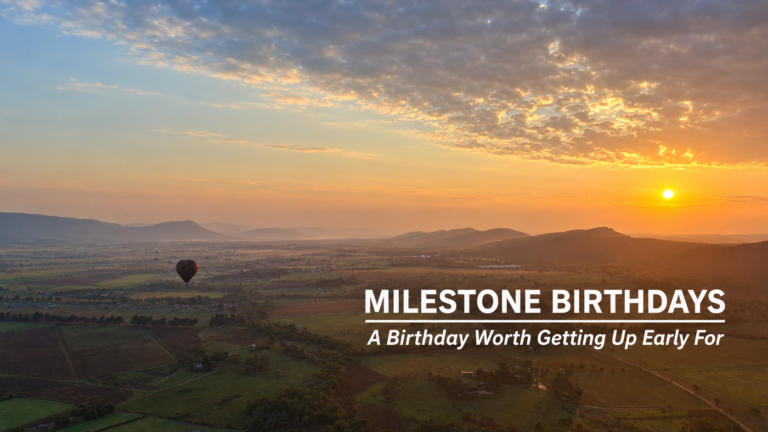
The Magaliesberg Mountains have watched over our landscape for millions of years. But long before hot air balloons floated above the valley, the story of these remarkable mountains began in a world almost impossible to imagine today.
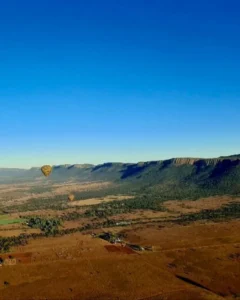
If you’ve ever visited Hartbeespoort, you’ll know the unmistakable silhouette of the Magaliesberg Mountains. Their rugged ridges, rocky cliffs and green slopes form one of the most recognisable landscapes in our region. But there’s something extraordinary hidden within those ancient rocks.
They preserve evidence of a time when parts of this landscape were covered by shallow water, with sandy environments shaped by moving waves and currents.
An Ancient Story Written in Stone
Long before the mountains took their present form, layers of sand accumulated in ancient environments that included shallow seas and coastal settings. Over immense stretches of geological time, these sediments were buried, compacted and transformed into sandstone and quartzite.
Some of the rock formations preserve ripple marks, delicate patterns left behind by water moving across sandy surfaces.
They’re remarkably similar to the little ridges you might notice in wet sand along a beach.
Except these patterns have survived in stone for an almost unimaginable length of time.
What we see today as towering mountain ridges is part of a geological story that began long before the landscape resembled anything familiar.
The Magaliesberg: More Than a Beautiful View
The Magaliesberg is among South Africa’s most remarkable ancient geological landscapes.
Its distinctive ridges have been shaped by geological processes and countless years of erosion, exposing rock formations that reveal clues about environments from the distant past.
Today, these mountains provide a spectacular backdrop to Hartbeespoort Dam, the Magalies River Valley and the surrounding countryside.
But knowing a little about their origins makes the scenery even more fascinating.
Those rocky ridges aren’t simply part of the view. They’re pages in an extraordinary natural history book.
A Different Perspective from the Sky
At Bill Harrop’s “Original” Balloon Safaris, we’ve had the privilege of sharing this magnificent landscape with guests since 1981.
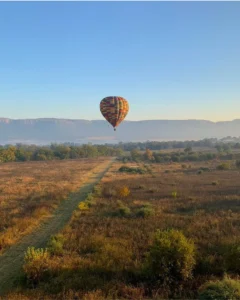
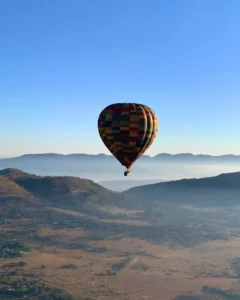
As the first light of morning reaches the Magaliesberg, the mountains gradually emerge from the shadows. The ridgelines catch the sunlight, the valleys reveal their contours and the countryside stretches towards the horizon.
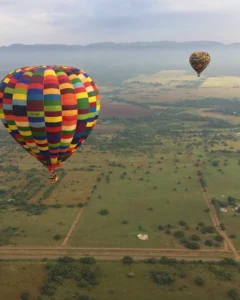
From a hot air balloon, the landscape takes on an entirely different character.
You begin to appreciate the scale of the mountains, the shape of the valleys and the extraordinary natural setting that makes this part of South Africa so special.
And when you consider that the rocks forming those distant ridges preserve evidence of ancient watery environments, the view becomes even more remarkable.
Some Stories Are Best Appreciated from Above
The Magaliesberg has witnessed changes on a scale that is difficult for us to comprehend.
Ancient waters have disappeared. Sediments have become stone. Geological forces and erosion have shaped the landscape into the mountains we recognise today.
And now, millions of years later, we have the remarkable privilege of drifting above this ancient countryside in a hot air balloon.
The next time you look towards the Magaliesberg, remember that you’re seeing far more than a beautiful mountain range.
You’re looking at an extraordinary piece of Earth’s history. And what a magnificent view it is.
Discover the beauty of the Magalies River Valley from a different perspective with Bill Harrop’s “Original” Balloon Safaris.
Explore Our Hot Air Balloon Experiences
Acknowledgement & Inspiration
This article was inspired by a fascinating geological insight shared by Philenco on Facebook, highlighting the ancient marine history preserved within the Magaliesberg Mountains. Our thanks to Philenco for sharing this remarkable piece of our region’s natural heritage and encouraging a deeper appreciation of the landscape surrounding Hartbeespoort.
Thank you for your continued support. We look forward to welcoming you on board.